Products
 Bars
Bars
 Beads & Spheres
 Bolts & Nuts
 Crucibles
 Discs
Discs
 Fibers & Fabrics
 Films
Films
 Flake
Flake
 Foams
Foams
 Foil
Foil
 Granules
 Honeycombs
 Ink
Ink
 Laminate
 Lumps
Lumps
 Meshes
 Metallised Film
 Plate
Plate
 Powders
 Rod
Rod
 Single Crystals
 Sputtering Target
 Tubes
Tubes
 Washer
 Wires
Wires
 Converters & Calculators
 Write for Us



Covalent Bond: Types and Examples

Introduction
Covalent bonds are a foundational concept in chemistry, forming the basis for the wide variety of substances found in nature. These bonds occur when two atoms share one or more pairs of electrons, allowing them to achieve a stable electron configuration similar to that of noble gases. Unlike ionic bonds, where electrons are transferred, covalent bonds involve electron sharing, making them crucial for the structure of both simple and complex molecules. From the water that sustains life to the intricate structures of organic compounds like proteins and DNA, covalent bonds are vital to chemistry, biology, and materials science.
Covalent Bond and the Octet Rule
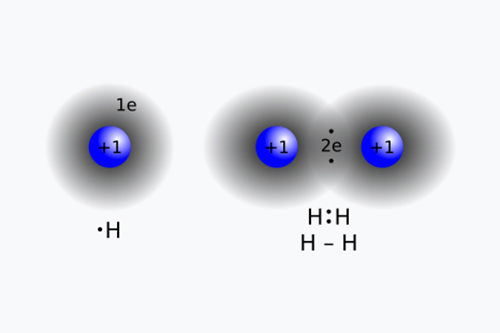
To understand how covalent bonds form, it is essential to first grasp the octet rule, which guides the bond formation process. The octet rule states that atoms tend to form bonds to achieve eight electrons in their outermost shell, the valence shell, a configuration considered stable because it mirrors the electron arrangement of noble gases. However, for hydrogen, the "duplet" rule applies, meaning it is stable with two electrons in its valence shell.
Atoms bond covalently to fill their outer shells, either by sharing one, two, or three pairs of electrons. This allows each atom to attain a full outer shell, ensuring stability in the molecule.
How Covalent Bonds Follow the Octet Rule
Let's take a look at how this works in different molecules:
- H₂-Hydrogen molecule: In this molecule, two hydrogen atoms share one electron each to give the stable H–H bond, satisfying the duplet rule.
- O₂ (Oxygen molecule): Each oxygen atom shares two electrons with the other, thus reaching a full outer shell of eight electrons.
- CH₄ (Methane): Here, carbon has shared four electrons with four hydrogen atoms and attains an octet to form a stable molecule.
Types of Covalent Bonds
Covalent bonds can be classified according to the number of electron pairs shared between atoms. These covalent bonds are generally classified as single, double, and triple bonds, with different strengths, bond lengths, and number of shared electrons.
Single Covalent Bonds
A single covalent bond involves the sharing of one pair of electrons between two atoms. This is the most common type of bond and is found in molecules such as hydrogen gas (H₂), methane (CH₄), and water (H₂O). While single bonds are generally weaker compared to multiple bonds, they are critical for the stability of a wide range of organic and inorganic compounds.
For instance, Hydrogen atoms share one pair of electrons in between them through a single covalent bond.
Double Covalent Bonds
In a double covalent bond, two pairs of electrons are shared between two atoms. These bonds are stronger and shorter than single bonds, providing more rigidity and affecting the molecule's reactivity. Double bonds are often seen in molecules like oxygen (O₂) and carbon dioxide (CO₂).
For example, the two oxygen atoms share two pairs of electrons, forming a stable double bond.
Triple Covalent Bonds
A triple covalent bond involves the sharing of three pairs of electrons between two atoms. These bonds are the strongest and shortest type of covalent bonds, providing substantial stability to the molecules. Among such triple-bonded molecules, nitrogen gas (N₂) is a prominent example.
For example, N₂ (Nitrogen molecule) contains three pairs of shared electrons between two nitrogen atoms, forming a triple bond that makes nitrogen gas highly stable.
Covalent Bond Structure
The electron pair geometry determines molecular geometry, which describes the three-dimensional arrangement of atoms in a covalently bonded molecule. This three-dimensional arrangement is determined by minimizing repulsion between electron pairs, and results in geometries characteristic of different molecules. Being able to describe and determine molecular geometries is an integral component of understanding the physical and chemical properties of compounds.
- Linear Geometry (180° bond angle): Obtained in molecules such as CO₂ (Carbon dioxide) where two atoms are connected in a straight line.
- Trigonal planar geometry: bond angle of 120°. The atoms are arranged in flat triangle which include BF₃ boron trifluoride
- Tetrahedral Geometry (109.5° bond angle). Present in CH₄, where four atoms are set around a central atom in a three-dimensional manner.
- Trigonal Bipyramidal Geometry: Molecules containing five atoms arranged around the central atom exhibit bond angles of both 90° and 120°. Examples are PCl₅, commonly known as Phosphorus pentachloride.
- Octahedral Geometry: The bond angle here is 90°, and this geometry is found in molecules like SF₆, which means six atoms surrounding the central atom symmetrically.
These geometries not only dictate the structural features of the molecule but also significantly affect its reactivity, polarity, and overall chemical behavior.
Covalent Bond vs Ionic Bond
While both covalent and ionic bonds are important in chemistry, they are in many ways opposite in how they form and in their properties. To provide a better comparison, let's contrast the two types of bonds in the table below:
|
Feature |
Covalent Bond |
Ionic Bond |
|
Electron Sharing |
Atoms share electrons to achieve stability. |
Atoms transfer electrons, forming oppositely charged ions. |
|
Bond Formation |
Formed between two nonmetals with similar electronegativity. |
Formed between a metal and a nonmetal with a large difference in electronegativity. |
|
Bond Strength |
Generally weaker than ionic bonds. |
Stronger due to electrostatic attraction between ions. |
|
Examples |
H₂, O₂, CH₄ |
NaCl, MgO, CaF₂ |
|
State at Room Temperature |
Usually gases or liquids (low melting/boiling points). |
Usually solid with high melting/boiling points. |
|
Electrical Conductivity |
Poor conductors in all states. |
Conduct electricity when molten or dissolved in water. |
|
Polarity |
Molecules can be polar or nonpolar based on symmetry. |
Always polar due to the presence of ions. |
|
Melting and Boiling Points |
Low melting and boiling points. |
High melting and boiling points due to strong ionic interactions. |
Frequently Asked Questions
1. What is a covalent bond?
A covalent bond is a chemical bond that involves the sharing of one or multiple pairs of electrons between two atoms that aims to accomplish a stable electron configuration.
2. In what ways are covalent bonds different from ionic bonds?
In covalent bonds, electrons are shared among atoms; however, in ionic bonds, electrons are transferred from one atom to another, causing oppositely charged ions.
3. What determines the type of covalent bond formed?
The type of covalent bondsingle, double or tripleis determined by the number of electron pairs shared between atoms.
4. Can covalent bonds be broken?
Yes, chemical reactions can break covalent bonds if the provided energy is large enough to overcome the bond strength; the formation of new bonds occurs.
5. Why is the structure of covalent bonds important?
The structure determines the shape of molecules and influences their physical and chemical properties, such as reactivity, polarity, and phase of matter.



 Chin Trento