Products
 Bars
Bars
 Beads & Spheres
 Bolts & Nuts
 Crucibles
 Discs
Discs
 Fibers & Fabrics
 Films
Films
 Flake
Flake
 Foams
Foams
 Foil
Foil
 Granules
 Honeycombs
 Ink
Ink
 Laminate
 Lumps
Lumps
 Meshes
 Metallised Film
 Plate
Plate
 Powders
 Rod
Rod
 Single Crystals
 Sputtering Target
 Tubes
Tubes
 Washer
 Wires
Wires
 Converters & Calculators
 Write for Us



Bonding Types and Van der Waals Forces

Introduction to Bonding
Why does salt dissolve in water? Why does wax melt? Why does a gecko's foot stick to glass? The answer in each case comes down to bonding—the forces that hold atoms and molecules together. Understanding the different types of bonding is crucial for explaining the properties of materials and the behavior of substances in various environments.
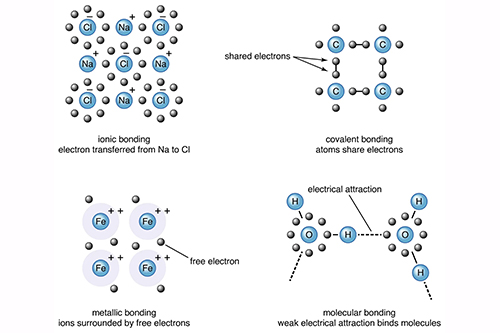
Types of Bonding
Ionic Bonding
Ionic bonding occurs when electrons are transferred from one atom to another, resulting in the formation of positively and negatively charged ions. This type of bonding typically occurs between metals and non-metals.
Covalent Bonding
Covalent bonding involves the sharing of electrons between atoms. This type of bonding is common between non-metal atoms and leads to the formation of molecules with specific geometric structures.
Metallic Bonding
Metallic bonding is characterized by a 'sea' of delocalized electrons that move freely around a lattice of metal cations. This type of bonding gives metals their characteristic properties, such as conductivity and malleability.
Van der Waals Forces
Van der Waals forces are weak intermolecular forces that arise from temporary dipoles in molecules. Despite their weakness compared to ionic or covalent bonds, Van der Waals forces play a significant role in the physical properties of many substances, such as boiling and melting points.
Van der Waals Forces in Detail
Van der Waals forces include London dispersion forces and dipole-dipole interactions. Hydrogen bonds, while also intermolecular, are significantly stronger and are typically treated separately. These forces are essential for understanding the behavior of molecules in different states of matter.
London Dispersion Forces
London dispersion forces are the weakest type of Van der Waals forces and occur due to the instantaneous polarization of electron clouds in atoms and molecules. They are present in all molecules, whether polar or nonpolar.
Dipole-Dipole Interactions
Dipole-dipole interactions occur between polar molecules, where the positive end of one molecule is attracted to the negative end of another. These forces are stronger than London dispersion forces and significantly affect the physical properties of substances.
Hydrogen Bonds
Hydrogen bonds are a special type of intermolecular force that occurs when hydrogen is bonded to highly electronegative atoms like nitrogen, oxygen, or fluorine. They are much stronger than typical dipole-dipole interactions—about 10–40 kJ/mol compared to 5–25 kJ/mol—and are essential for the structure of water, DNA, and proteins.
Comparative Overview of Bonding Types
|
Type of Bonding |
Strength |
Typical Materials |
Key Properties |
|
Ionic Bonding |
High |
Metals and Non-metals |
High melting points, brittle |
|
Covalent Bonding |
Variable (typically 150–1000 kJ/mol) |
Non-metals |
Variable melting points, directional |
|
Metallic Bonding |
Moderate to High |
Conductive, malleable |
|
|
Van der Waals Forces |
Weak |
All molecules |
Influences boiling/melting points |
Related Materials from Stanford Advanced Materials
Stanford Advanced Materials (SAM) supplies materials for research on molecular interactions and surface chemistry:
- Polymers and organic compounds: For investigating van der Waals interactions
- Surface treatment materials: For modifying adhesion and wettability
[Browse our products] or [contact us] for specifications.
Frequently Asked Questions
What is the primary difference between ionic and covalent bonding?
Ionic bonding involves the transfer of electrons from one atom to another, resulting in the formation of charged ions, whereas covalent bonding involves the sharing of electrons between atoms to form molecules.
How do Van der Waals forces affect the properties of substances?
Van der Waals forces influence the boiling and melting points of substances, as well as their solubility and physical state at room temperature.
Can Van der Waals forces exist between nonpolar molecules?
Yes, Van der Waals forces, specifically London dispersion forces, can occur between nonpolar molecules due to temporary fluctuations in electron density.

 Chin Trento