Products
 Bars
Bars
 Beads & Spheres
 Bolts & Nuts
 Crucibles
 Discs
Discs
 Fibers & Fabrics
 Films
Films
 Flake
Flake
 Foams
Foams
 Foil
Foil
 Granules
 Honeycombs
 Ink
Ink
 Laminate
 Lumps
Lumps
 Meshes
 Metallised Film
 Plate
Plate
 Powders
 Rod
Rod
 Single Crystals
 Sputtering Target
 Tubes
Tubes
 Washer
 Wires
Wires
 Converters & Calculators
 Write for Us



Temperature Conversion: Celsius to Fahrenheit

Introduction
Temperature affects nearly everything in our lives—roasting a flawless piece of meat to predicting tomorrow's forecast or performing scientific testing. We're too often dealing with temperatures given in both Celsius (°C) and Fahrenheit (°F), and it is necessary to convert between them for precision and even for safety. Whether you're reading a recipe from abroad, studying a weather forecast, or operating in a laboratory setting, temperature scales and conversions are something to know.
What Temperature Is
Temperature is a measurement of the average energy of motion of particles in a material. Another way of putting it is that temperature indicates how vibrantly the atoms and molecules of an object are moving: more rapid motion, higher temperature; more sedate motion, lower temperature.
Imagine a cup of hot coffee: molecules are zipping about, imparting heat to your hand. Ice water has molecules moving much less quickly. Temperature is the way we quantify that motion so we can control, compare, and predict thermal effects in everyday life and in science.
How Temperature Is Measured
Temperature can be measured in several ways, depending on the application:
• Thermometers: Use the expansion of liquids (e.g., mercury or alcohol) or solid materials to indicate temperature on a scale.
• Digital Sensors: Measure electrical resistance, voltage, or infrared radiation to produce correct readings.
• Thermocouples: Two different metals generate a temperature-proportional voltage used widely in industry and the lab.
• Infrared Cameras: Measure radiated infrared radiation to map temperature onto surfaces, used in engineering, electronics, and medical imaging.
Each method provides a snapshot of molecular movement, and knowledge of the scale (Celsius versus Fahrenheit) enables proper interpretation.
Why Temperature is Important
Temperature is important because it directly affects physical, chemical, and biological processes. Some hands-on examples:
•Cooking: Food safety depends upon reaching the proper internal temperature. Chicken must reach 74°C / 165°F in order to destroy bacteria.
• Science & Engineering: Rates of chemical reactions and material properties often depend upon correct temperature. Hardening steel, for instance, is done by heating to exactly 800–900°C (1472–1652°F).
• Weather & Travel: Correct temperatures ensure proper dress, travel, and safety in the event of heatwaves or frosts.
• Healthcare: Body temperature is a significant health indicator; normal is 37°C (98.6°F), while deviations may indicate illness.
Temperature is not a number—it's an essential performance, safety, and comfort driver in countless industries.
Celsius and Fahrenheit Scales
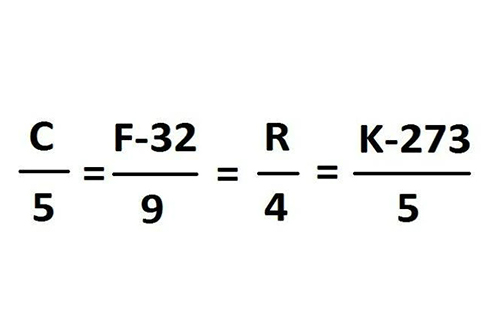
The Celsius and Fahrenheit temperature scales are the most used worldwide. Celsius, as it forms part of the metric system, is used frequently in scientific contexts and in most countries. Fahrenheit, used only in the United States, is ubiquitous in everyday usage like weather forecasts and cooking.
Celsius (°C): Based on the freezing point and boiling point of water at 0°C and 100°C, respectively.
Fahrenheit (°F): Sets the freezing point of water at 32°F and the boiling point at 212°F.
Practical Applications
Temperature conversion is necessary in different fields:
•Cooking: Temperature adjustment of recipes according to temperature readings.
•Travel: Understanding weather patterns in different countries.
•Science and Engineering: Maintaining accurate measurements and experiments.
•Healthcare: Understanding body temperature across regions.
Temperature Conversion Table
Here’s a Temperature Conversion Table for common temperature scales:
|
Temperature (°C) |
Fahrenheit (°F) |
Kelvin (K) |
Rankine (°R) |
|
-40 |
-40 |
233.15 |
419.67 |
|
-30 |
-22 |
243.15 |
437.67 |
|
-20 |
-4 |
253.15 |
455.67 |
|
-10 |
14 |
263.15 |
471.67 |
|
0 |
32 |
273.15 |
491.67 |
|
10 |
50 |
283.15 |
509.67 |
|
20 |
68 |
293.15 |
527.67 |
|
25 |
77 |
298.15 |
536.67 |
|
30 |
86 |
303.15 |
545.67 |
|
40 |
104 |
313.15 |
563.67 |
|
50 |
122 |
323.15 |
581.67 |
|
60 |
140 |
333.15 |
599.67 |
|
70 |
158 |
343.15 |
617.67 |
|
80 |
176 |
353.15 |
635.67 |
|
90 |
194 |
363.15 |
653.67 |
|
100 |
212 |
373.15 |
671.67 |
Note:
1. Celsius to Fahrenheit:
F=(C×9/5)+32
2. Celsius to Kelvin:
K=C+273.15
3. Celsius to Rankine:
R=(C+273.15)×9/5
For more information, please check Stanford Advanced Materials (SAM).
Frequently Asked Questions
How do I convert Celsius to Fahrenheit?
Multiply the temperature in Celsius by 9/5 and add 32 to get Fahrenheit.
How do I convert Fahrenheit to Celsius?
Take away 32 from the temperature in Fahrenheit and multiply by 5/9 to get Celsius.
Why are Fahrenheit and Celsius scales having different origins?
They were developed independently having different origins based on different requirements and historical conditions.
Yes, -40 degrees is the point at which Celsius and Fahrenheit scales intersect.
Which countries make widespread use of the Celsius scale?
Most countries around the world use Celsius, especially in science and international use.


 Chin Trento