
 Products
 Bars
Bars
 Beads & Spheres
 Bolts & Nuts
 Crucibles
 Discs
Discs
 Fibers & Fabrics
 Films
Films
 Flake
Flake
 Foams
Foams
 Foil
Foil
 Granules
 Honeycombs
 Ink
Ink
 Laminate
 Lumps
Lumps
 Meshes
 Metallised Film
 Plate
Plate
 Powders
 Rod
Rod
 Single Crystals
 Sputtering Target
 Tubes
Tubes
 Washer
 Wires
Wires
 Converters & Calculators
 Write for Us



Reference Angle Calculator

Understanding Reference Angles
What Is a Reference Angle
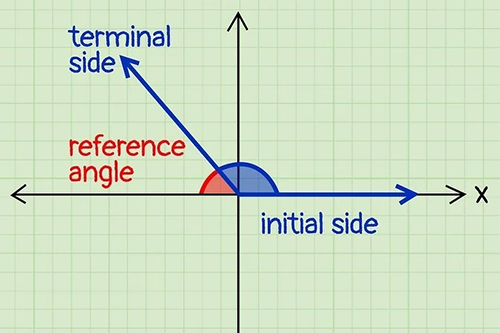
A reference angle is the smallest angle between the terminal side of a given angle and the x-axis. It is always a positive acute angle measured in degrees.
Importance of Reference Angles in Trigonometry
Reference angles simplify the evaluation of trigonometric functions by reducing angles to their acute equivalents.
Using a Reference Angle Calculator
Steps to Calculate Reference Angles
- Identify the quadrant where the angle lies.
- Subtract the angle from the nearest x-axis (0°, 180°, 360°) to find the reference angle.
Example Calculation
Consider an angle of 225 degrees:
- It lies in the third quadrant.
- Reference angle = 225° - 180° = 45°.
Reference Angle Table
|
Quadrant |
Angle Range (degrees) |
Reference Angle Calculation |
|
I |
0° to 90° |
Reference Angle = Angle |
|
II |
90° to 180° |
Reference Angle = 180° - Angle |
|
III |
180° to 270° |
Reference Angle = Angle - 180° |
|
IV |
270° to 360° |
Reference Angle = 360° - Angle |
For more information, please check Stanford Advanced Materials (SAM).
Frequently Asked Questions
What is a reference angle?
A reference angle is the smallest positive acute angle between the terminal side of a given angle and the x-axis.
Why are reference angles important in trigonometry?
They simplify the computation of trigonometric functions by allowing the use of known values for acute angles.
How do you determine the quadrant of an angle?
By the angle's degree measure: 0°-90° Quadrant I, 90°-180° Quadrant II, etc.
Can reference angles be negative?
No, reference angles are always positive acute angles.
Is a reference angle always less than 90 degrees?
Yes, by definition, a reference angle is always an acute angle, less than 90 degrees.


 Chin Trento