
 Products
 Bars
Bars
 Beads & Spheres
 Bolts & Nuts
 Crucibles
 Discs
Discs
 Fibers & Fabrics
 Films
Films
 Flake
Flake
 Foams
Foams
 Foil
Foil
 Granules
 Honeycombs
 Ink
Ink
 Laminate
 Lumps
Lumps
 Meshes
 Metallised Film
 Plate
Plate
 Powders
 Rod
Rod
 Single Crystals
 Sputtering Target
 Tubes
Tubes
 Washer
 Wires
Wires
 Converters & Calculators
 Write for Us



Magnetic Properties and Applications

From energy generation to data storage and medical imaging, magnetic properties are essential for a wide range of modern technologies. In all these technologies, magnets and the magnetic behaviors of materials form the core. We will take a closer look at some of the basic concepts underlying magnetic properties: magnetic dipoles, fields, and moments, and we touch upon their applications in industry, medicine, and beyond.
Magnetic Dipole
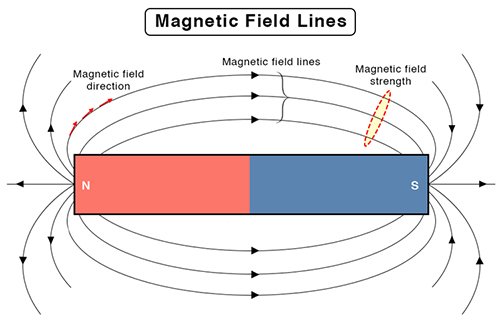
The simplest manifestation of magnetism would be a magnetic dipole, and it is essentially a set of two equal and opposite magnetic charges, or poles, separated by some distance. These poles are conventionally referred to as the north pole and the south pole, and the magnetic moment of the dipole characterizes both the strength and the orientation of the dipole. Magnetic dipoles align in external applied fields, undergoing torque because of an interaction with that field.
The magnetic dipole provides the conceptual basis for the understanding of more complicated magnetic phenomena of materials and devices. A bar magnet or an electrical current-containing coil forms a magnetic dipole that can align with external fields.
Magnetic Field
A magnetic field is a vector field that describes the magnetic influence on moving electric charges, currents, and magnetic materials. It is an essential ingredient for the operation of many electronic devices and in the response of various materials to magnetic conditions. Sources of magnetic fields include:
- Permanent Magnets: These are materials that produce a permanent magnetic field with no requirement for an external power input.
- Electric Currents: Magnetic fields are generated around conductors by moving electric charges or currents according to Ampère's law.
- Changing Electric Fields: Changing electric fields induce magnetic fields according to Maxwell's equations.
The magnetic field is a quantity measured in Tesla, and its strength and direction are two important means of understanding the response of materials to it.
Magnetic Moments
Magnetic moments are a property inherent in materials and stem from the motion of electric charges, as well as the intrinsic spin of such elementary particles as electrons. These moments determine the torque which a material in a magnetic field experiences and its ability to become magnetized.
There are three main kinds of magnetic moments:
1. Orbital Magnetic Moment: Results from electrons moving around the atomic nucleus.
2. Spin Magnetic Moment: property intrinsic to particles like electrons that have a spin.
3. Total Magnetic Moment: Comprising both an orbital and a spin magnetic moment, this gives the overall magnetic behavior of the material.
It is usually measured in A·m², which stands for Ampere square meters, and it is an important determinant of the strength and orientation of materials in magnetic fields.
Magnetic Strength
Magnetic strength refers to the intensity of a magnetic field and its ability to influence materials and electric charges. It is often described using parameters like magnetic flux density, measured in Tesla, and magnetic field strength, usually measured in Ampere per meter, A/m.
Various factors affect magnetic strengths, these include:
- Magnetic properties of the material permeability and susceptibility.
- Distance from the magnetic source, since field strength falls off with distance according to the inverse-square law.
- Alignment and configuration of magnetic dipoles or sources
Comparison Table of Magnetic Properties
|
Property |
Description |
Unit |
|
Magnetic Dipole |
Basic magnetic entity with north and south poles |
A·m² (Ampere square meters) |
|
Magnetic Field |
Vector field representing magnetic influence |
Tesla (T) |
|
Magnetic Moment |
Measure of the strength and orientation of a magnet |
A·m² |
|
Magnetic Strength |
Intensity of the magnetic field |
Ampere per meter (A/m) |
Classification of Magnets
The magnets can be classified depending on their properties and magnetic behavior when in the presence of an external magnetic field. Such a classification is important for the wide application range that magnets have in modern technology.
1. Permanent Magnets: These magnets retain their magnetic properties over time without needing any external power source. They are normally manufactured from materials with very high magnetic permeability.
Examples include: Neodymium, Samarium-Cobalt, Alnico, Ferrite.
2. Orange Magnets: It is a magnet to which the magnetic field of Earth induces a magnetization opposite in the direction. The opposite of a red magnet, it is repelled by the South Pole and attracts the North Pole.
3. Electromagnets: These are the magnets that, upon the passage of an electric current through them, generate a magnetic field. The strength of such a field is controlled by the current. These kinds of magnets find broad applications in motors, relays, and magnetic cranes.
4. Soft Magnets: Materials that are easily magnetized and demagnetized. They possess low coercivity; hence, they get easily magnetized with a small field and demagnetized.
Examples: Soft iron and silicon steel.
5. Hard Magnets: Those that remain magnetized long after the external field is removed. These have high coercivity and are used to manufacture permanent magnets.
Examples: Neodymium and Samarium-Cobalt.
Applications of Magnets
The magnetic properties of materials allow them to be applied in a wide range of applications within many industries, from electronics to medicine. Among the main applications of magnets are:
1. Magnetic Data Storage: Permanent magnets are used in hard drives, which store information as magnetized regions on the surface of a magnetic disk.
2. Motors and Generators: Basically, motors and generators depend on the interaction of magnetic fields with electrical currents to provide motion and electrical energy, using electromagnets and sometimes permanent magnets.
3. MRI Machines: Strong permanent magnets are a fundamental constituent of MRI, or Magnetic Resonance Imaging machines, as they provide the strong magnetic fields necessary for high-resolution imaging into the internal structures of the body.
4. Magnetic Levitation: The superconducting magnets in a maglev train create magnetic fields that lift the train and move it without touching the tracks; reducing friction allows for more speed and a smoother movement.
5. Refrigeration: Magnetic cooling systems make use of the magnetocaloric effect for offering an environmentally friendly alternative to traditional refrigeration systems. These systems use the magnetic properties of certain materials to cool objects when exposed to a changing magnetic field.
6. Speakers and Audio Devices: Neodymium magnets are widely utilized in loudspeakers and headphones to convert electrical signals into sound. Their strong magnetic fields enable the efficient movement of speaker diaphragms.
7. Sensors: Magnetic sensors find a wide range of applications, from automotive systems to consumer electronics and industrial equipment, including speedometers, position sensors, smartphone compasses, and current sensors.
8. Mining and Recycling: Electromagnets are utilized in industry to lift heavy metal objects, sort materials, and extract ferrous metals from ores.
Frequently Asked Questions
What is a magnetic dipole?
A magnetic dipole contains a pair of magnetic poles, equal and opposite in magnitude, separated by some distance and is considered the simplest type of magnet.
How is a magnetic field generated?
Magnetic fields are created either by the motion of electric charges, such as electric currents, or by changing electric fields.
What determines the magnetic moment of a material?
The magnetic moment is determined by the motion of electrons, including both their orbital and spin contributions, within the material.
How does magnetic strength vary with distance?
Magnetic strength often drops with the square of distance from a source and follows the inverse-square law.
Why are magnetic properties important in technology?
Applications of magnetic properties include important features in many technological devices such as motors, generators, MRI, and data storage devices, among others. In addition, new technologies such as magnetic refrigeration and maglev transportation are also being explored.
 Chin Trento