
 Products
 Bars
Bars
 Beads & Spheres
 Bolts & Nuts
 Crucibles
 Discs
Discs
 Fibers & Fabrics
 Films
Films
 Flake
Flake
 Foams
Foams
 Foil
Foil
 Granules
 Honeycombs
 Ink
Ink
 Laminate
 Lumps
Lumps
 Meshes
 Metallised Film
 Plate
Plate
 Powders
 Rod
Rod
 Single Crystals
 Sputtering Target
 Tubes
Tubes
 Washer
 Wires
Wires
 Converters & Calculators
 Write for Us



Permittivity: Basics and Examples

What Is Permittivity
Permittivity measures how an electric field affects and is affected by a dielectric medium. It is crucial in various materials and solutions.
Permittivity is a fundamental property that quantifies a material's ability to transmit electric fields. It plays a vital role in determining how electric fields interact with different substances, affecting the behavior of capacitors, insulators, and various electronic components.
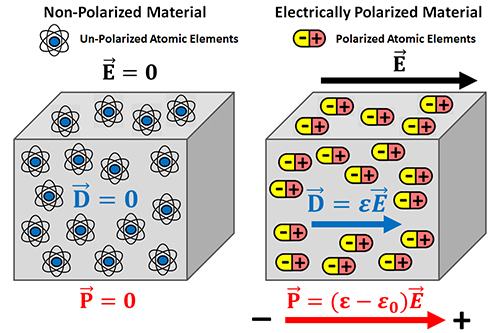
Types of Permittivity
There are two primary types of permittivity:
- Absolute Permittivity (ε): The measure of permittivity in a vacuum.
- Relative Permittivity (εr): The ratio of a material's permittivity to that of a vacuum.
Understanding these types helps in designing and selecting materials for specific electrical applications.
Importance in Materials Science
Permittivity is essential in materials science for:
- Designing Capacitors: Higher permittivity materials allow for greater energy storage.
- Insulation: Materials with low permittivity are used to prevent unwanted electric field interactions.
- Electronics: Permittivity influences the performance of various electronic components, including transistors and semiconductors.
Permittivity of Common Materials and Solutions
Permittivity in Everyday Materials
Different materials exhibit varying permittivity values, influencing their suitability for specific applications. Here's a table summarizing the permittivity of some common materials:
|
Material |
Relative Permittivity (εr) |
|
Vacuum |
1 |
|
Air |
~1.0006 |
|
Water |
~80 |
|
Glass |
~4-10 |
|
Aluminum Oxide |
~9-10 |
|
~2.25 |
|
|
Silicon Dioxide |
~3.9 |
|
Teflon |
~2.1 |
|
Rubber |
~2-5 |
|
Concrete |
~4-10 |
For more information, please check Stanford Advanced Materials (SAM).
Permittivity in Solutions
Solutions, especially electrolytic solutions, have permittivity values that significantly impact their electrical properties. The permittivity of water-based solutions typically ranges from 60 to 80, depending on the concentration of ions and temperature. Higher ionic concentrations generally lead to lower permittivity due to increased conductivity.
|
Solution Type |
Relative Permittivity (εr) |
|
Pure Water |
~80 |
|
Saltwater (High Salinity) |
~60 |
|
Sugar Solution |
~70 |
|
Alcohol Solution |
~25 |
|
Acidic Solution |
~65 |
Factors Affecting Permittivity
Several factors influence the permittivity of a material or solution:
- Frequency of the Electric Field: Permittivity can vary with the frequency, especially in dielectric materials.
- Temperature: Increased temperatures can alter molecular polarization, affecting permittivity.
- Material Composition: The molecular structure and bonding within a material determine its ability to polarize in an electric field.
Applications of Permittivity
Understanding permittivity is crucial in various applications:
- Telecommunications: Permittivity affects signal transmission through different media.
- Medical Devices: Capacitive sensors rely on permittivity changes to detect biological signals.
- Energy Storage: Batteries and supercapacitors utilize materials with specific permittivity to enhance performance.
Frequently Asked Questions
What is permittivity and why is it important?
Permittivity measures a material's ability to permit electric field lines. It's crucial for designing electronic components and understanding how materials interact with electric fields.
How does permittivity differ from permeability?
Permittivity relates to electric fields, while permeability relates to magnetic fields. Both are fundamental in describing electromagnetic properties of materials.
Can permittivity be negative?
Under certain conditions, such as in metamaterials, permittivity can exhibit negative values, leading to unusual electromagnetic properties.
How is permittivity measured?
Permittivity is typically measured using techniques like capacitance measurements, where the response of a material to an electric field is quantified.
Does temperature affect permittivity?
Yes, temperature changes can influence permittivity by altering the material's molecular structure and polarization characteristics.

 Chin Trento