
 Products
 Bars
Bars
 Beads & Spheres
 Bolts & Nuts
 Crucibles
 Discs
Discs
 Fibers & Fabrics
 Films
Films
 Flake
Flake
 Foams
Foams
 Foil
Foil
 Granules
 Honeycombs
 Ink
Ink
 Laminate
 Lumps
Lumps
 Meshes
 Metallised Film
 Plate
Plate
 Powders
 Rod
Rod
 Single Crystals
 Sputtering Target
 Tubes
Tubes
 Washer
 Wires
Wires
 Converters & Calculators
 Write for Us



Introduction to Specific Heat Capacity

What Is Specific Heat Capacity
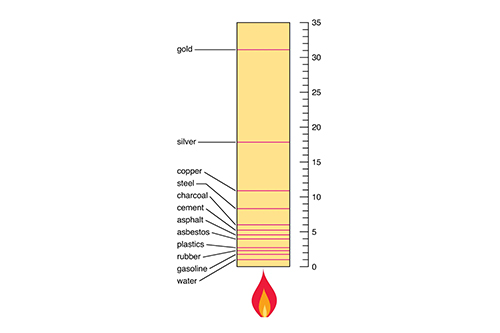
Specific heat capacity is a property that describes how much heat energy is required to raise the temperature of a unit mass of a substance by one degree Celsius. It is a fundamental concept in thermodynamics and plays a crucial role in understanding how different materials respond to heat.
How to Calculate Specific Heat Capacity
The specific heat capacity (cc) of a substance is the amount of heat required to raise the temperature of a unit mass of the substance by one degree Celsius (or one Kelvin). The equation for specific heat capacity is:
Q=m*c*ΔT
Where:
- Q = Heat energy added (Joules, J)
- m = Mass of the substance (kg)
- c = Specific heat capacity (J/kg·°C or J/kg·K)
- ΔT = Change in temperature (°C or K)
Specific Heat Capacity vs Heat Capacity
While both terms relate to heat energy, specific heat capacity and heat capacity are distinct concepts. Heat capacity refers to the amount of heat energy required to change the temperature of an entire object, regardless of its mass. In contrast, specific heat capacity is the amount of heat energy needed to raise the temperature of a unit mass of a substance by one degree Celsius.
|
Feature |
Specific Heat Capacity |
Heat Capacity |
|
Definition |
Heat required to raise temperature of 1 kg by 1°C |
Heat required to raise temperature of object |
|
Units |
J/(kg·°C) |
J/°C |
|
Dependence on Mass |
Independent |
Depends on mass |
|
Application Example |
Calculating heat for 100g of water |
Determining heat for a 1kg metal rod |
Examples of Specific Heat Capacity
Different materials have different specific heat capacities. For instance:
- Water has a high specific heat capacity, making it effective in regulating temperatures.
- Aluminum has a lower specific heat capacity compared to water, which means it heats up and cools down quickly.
- Iron has a relatively low specific heat capacity (450 J/kg·°C), which means it responds to temperature changes faster than materials like water or aluminum.
Here's a table showing the specific heat capacity of various substances:
|
Substance |
Specific Heat Capacity (J/kg·°C or J/kg·K) |
|
Water |
4186 |
|
Ice |
2090 |
|
Iron |
450 |
|
Copper |
385 |
|
Aluminum |
900 |
|
Lead |
128 |
|
Glass |
840 |
|
Ethanol |
2430 |
|
Wood (oak) |
1700 |
|
Air (at 20°C) |
1005 |
|
Gold |
129 |
|
Mercury |
138 |
Stanford Advanced Materials (SAM) supplies many of the materials listed above—including metals, ceramics, and composites—for research and industrial applications. [Contact us] for technical data sheets or material specifications.
Frequently Asked Questions
What factors affect specific heat capacity?
Factors include the material's molecular structure, phase of matter, and temperature.
Why does water have a high specific heat capacity?
Water's hydrogen bonding allows it to absorb more heat without a significant temperature change.
How is specific heat capacity used in real life?
It's used in designing heating and cooling systems, cooking, and understanding climate dynamics.
Can specific heat capacity change with temperature?
Yes, for some materials, specific heat capacity varies with temperature.
Is specific heat capacity the same for all states of matter?
No, different states (solid, liquid, gas) of the same substance can have different specific heat capacities.
 Chin Trento