
 Products
 Bars
Bars
 Beads & Spheres
 Bolts & Nuts
 Crucibles
 Discs
Discs
 Fibers & Fabrics
 Films
Films
 Flake
Flake
 Foams
Foams
 Foil
Foil
 Granules
 Honeycombs
 Ink
Ink
 Laminate
 Lumps
Lumps
 Meshes
 Metallised Film
 Plate
Plate
 Powders
 Rod
Rod
 Single Crystals
 Sputtering Target
 Tubes
Tubes
 Washer
 Wires
Wires
 Converters & Calculators
 Write for Us



Refractive Index: Basics and Examples

What Is Refractive Index
Definition
The refractive index is a dimensionless number that describes how light propagates through a medium. It indicates the degree to which light slows down and changes direction when entering a material from another medium, such as air.
Importance in Optics
Understanding the refractive index is essential for designing optical devices like lenses, prisms, and fiber optics. It determines how light will behave when interacting with different materials, affecting image clarity and light transmission.
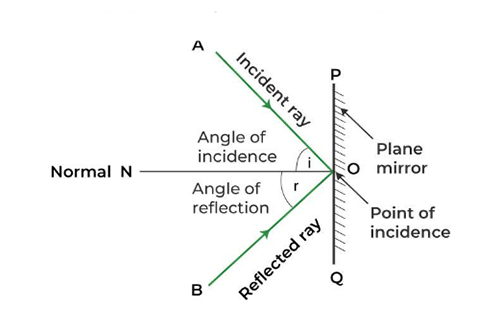
Factors Affecting Refractive Index
Material Composition
Different materials have unique atomic and molecular structures that influence their refractive indices. For example, denser materials like glass have higher refractive indices compared to less dense materials like air.
Wavelength of Light
The refractive index can vary with the wavelength of light, a phenomenon known as dispersion. This variation causes different colors of light to bend by different amounts, which is why prisms can separate white light into a spectrum of colors.
List of Refractive Indices
Here's a table that classifies the materials mentioned in the previous list of refractive indices into different states of matter (liquids, solids, gases, etc.).
|
Material |
State of Matter |
Refractive Index (n) |
|
Vacuum |
Gas |
1.0000 |
|
Air |
Gas |
1.0003 |
|
Water |
Liquid |
1.333 |
|
Glycerol |
Liquid |
1.473 |
|
Ethanol |
Liquid |
1.36 |
|
Benzene |
Liquid |
1.50 |
|
Mercury |
Liquid (Metal) |
1.71 |
|
Glass (typical) |
Solid |
1.5 |
|
Quartz |
Solid |
1.544 |
|
Sapphire |
Solid |
1.762 |
|
Polycarbonate |
Solid (Plastic) |
1.586 |
|
Sodium Chloride |
Solid |
1.544 |
|
Ruby |
Solid |
1.76 |
|
Polystyrene |
Solid (Plastic) |
1.59 |
|
Titanium Dioxide (TiO₂) |
Solid |
2.4–2.7 |
|
Zinc Sulfide (ZnS) |
Solid |
2.37 |
|
Diamond |
Solid |
2.42 |
|
Lead Glass (PbO glass) |
Solid |
1.7–2.0 |
|
Silicon |
Solid |
3.42 |
|
Gallium Arsenide (GaAs) |
Solid |
3.3 |
For more information, please check Stanford Advanced Materials (SAM).
Refractive Index in Crystals
Optical Properties of Crystals
Crystals exhibit unique refractive indices that contribute to their optical properties, such as birefringence. Birefringent materials have different refractive indices along different axes, causing light to split into two beams with distinct paths.
Applications in Technology
Crystals with specific refractive indices are integral in various technologies, including lasers, optical fibers, and precision instruments. Their ability to manipulate light accurately makes them valuable for enhancing performance in these applications.
Refractive Index in Glass
Types of Glass
Glass comes in various types, each with its own refractive index range. Common types include:
- Crown Glass: Refractive index around 1.52
- Flint Glass: Refractive index around 1.62
- Borosilicate Glass: Refractive index around 1.47
Impact on Optical Devices
The refractive index of glass affects the design and functionality of optical devices. Higher refractive indices allow for thinner lenses with greater light-bending capabilities, improving the efficiency and compactness of devices like cameras, microscopes, and eyeglasses.
Frequently Asked Questions
What is the refractive index of diamond?
The refractive index of diamond is approximately 2.42, making it one of the
highest among naturally occurring materials, which contributes to its
brilliance.
How does the refractive index affect lens design?
A higher refractive index allows lenses to be made thinner and lighter while
maintaining their ability to bend light effectively, enhancing optical
performance.
Can the refractive index change with temperature?
Yes, the refractive index can vary with temperature, affecting how light
propagates through a material and potentially altering the performance of
optical devices.
What is birefringence in crystals?
Birefringence is the difference in refractive indices in a crystal along
different axes, causing incoming light to split into two separate beams with
distinct velocities and paths.
Why is glass commonly used in optical devices?
Glass offers a suitable range of refractive indices, transparency, and ease of
manufacturing, making it ideal for lenses, prisms, and other components in
optical devices.
 Chin Trento