
 Products
 Bars
Bars
 Beads & Spheres
 Bolts & Nuts
 Crucibles
 Discs
Discs
 Fibers & Fabrics
 Films
Films
 Flake
Flake
 Foams
Foams
 Foil
Foil
 Granules
 Honeycombs
 Ink
Ink
 Laminate
 Lumps
Lumps
 Meshes
 Metallised Film
 Plate
Plate
 Powders
 Rod
Rod
 Single Crystals
 Sputtering Target
 Tubes
Tubes
 Washer
 Wires
Wires
 Converters & Calculators
 Write for Us



VSEPR Theory and Molecular Shapes

What Is VSEPR Theory?
Valence Shell Electron Pair Repulsion Theory is a model that helps us understand how atoms arrange themselves in molecules. It focuses on the idea that electron pairs around a central atom push away from each other. This push creates specific molecular shapes. The model gives us a way to predict how atoms will orient in space. It has become a common tool in chemistry. Teachers and experienced chemists use it to explain molecular structure with ease. The theory is not only useful in academic settings but also in applied fields like engineering and materials science.
What Does VSEPR Stand For?
VSEPR stands for Valence Shell Electron Pair Repulsion. The term “valence shell” refers to the outer layer of electrons in an atom. “Electron pair” means two electrons that occur together around the nucleus. “Repulsion” explains why these pairs try to stay apart. In simple words, electron pairs push each other away. This repulsion drives the three-dimensional arrangement of atoms.
Basic Postulates of VSEPR Theory
The heart of the theory rests on a few simple ideas.
1. First, electron pairs located in the valence shell of a central atom are repelled by each other.
2. Second, this repulsion causes the electron pairs to arrange themselves as far away from each other as possible.
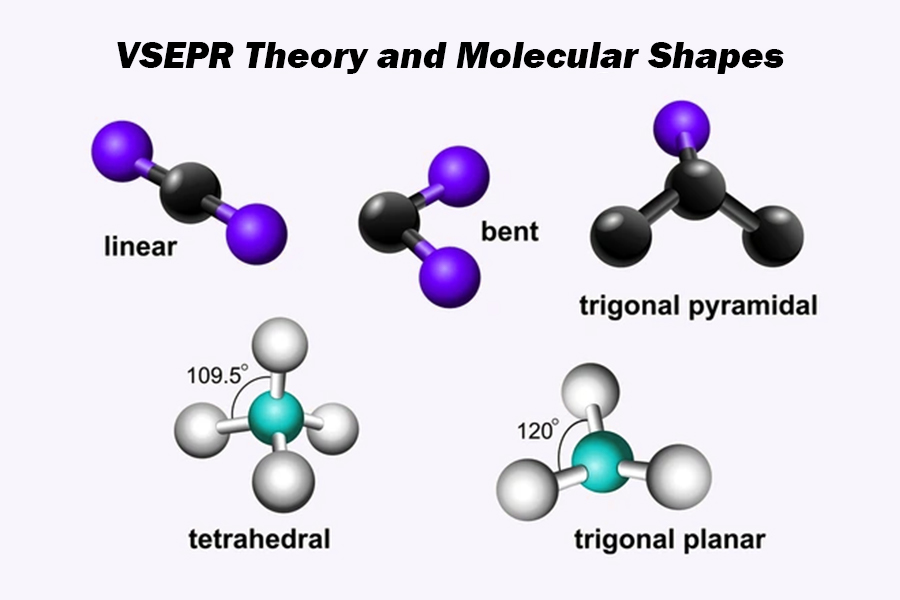
3. Third, the observed molecular shape is influenced by both bonding pairs and lone pairs of electrons. For example, in a molecule with four bonding pairs and no lone pairs, the shape tends to be tetrahedral. When there are lone pairs, the shape adjusts to accommodate extra repulsion.
This is why water, which has two bonding pairs and two lone pairs, has a bent shape instead of a tetrahedral one. Each lone pair pushes more strongly than a bonding pair. This simple idea helps scientists understand and predict shapes of molecules.
Molecular vs. Electron Geometry
It is important to note there is a difference between molecular geometry and electron geometry. Electron geometry takes into account all electron pairs around the central atom. It considers bonding pairs as well as lone pairs. Molecular geometry, on the other hand, only shows the arrangement of atoms. For example, a molecule with four electron pairs could have a tetrahedral electron geometry. If one pair is a lone pair, the molecular shape may become trigonal pyramidal. This distinction helps to explain why molecules with identical electron geometries sometimes have different shapes. By understanding both concepts, one gains a deeper insight into the structure of molecules.
Common VSEPR Shapes and Their Bond Angles
There are several common shapes that arise from VSEPR Theory.
The simplest shape is the linear form. In a linear molecule, the bond angle is typically 180°. A bent shape occurs when there are two bonding pairs and one or more lone pairs. In such cases, the angle is about 104.5°, as seen in water.
Another familiar shape is the trigonal planar form, where the bond angles are around 120°. When molecules contain four electron pairs, the tetrahedral shape forms with bond angles of about 109.5°. If a lone pair replaces one bonding pair, the geometry is described as trigonal pyramidal with similar bond angles.
The square planar shape is less common. This form is usually found in complex ions with a central atom surrounded by four atoms at 90° angles. There are also more complex shapes like seesaw, T-shaped, and octahedral.
Each shape has bond angles that are close to those standard values. Real-life molecules may show slight variations due to differences in size and electronegativity of the substituents.
How to Use a VSEPR Chart
Using a VSEPR chart is straightforward. One begins by counting the number of electron pairs around the central atom. This count includes both bonding and lone pairs. The next step is to match the count to the corresponding electron geometry on the chart. Next, identify what parts of the electron pairs are bonding pairs and what parts are lone pairs. The chart gives a visual reminder of the expected molecular shape. For instance, a central atom with four electron pairs usually forms a tetrahedral geometry. However, if one of these pairs is a lone pair, the shape changes to a trigonal pyramidal geometry. A well-prepared VSEPR chart will list all common scenarios. It also shows the approximate bond angles for each geometry. You can refer to such a chart during class or research work. This method can be especially helpful when dealing with more complex molecules. For more tech information and support, please check Stanford Advanced Materials (SAM).
Conclusion
In summary, Valence Shell Electron Pair Repulsion Theory gives us a clear way to predict the shape of a molecule. The theory rests on the simple idea that electron pairs repel one another. By counting electron pairs and using a VSEPR chart, one can determine both the electron geometry and the molecular geometry. This simple model remains valuable in classrooms and labs alike. It plays an important role in understanding chemical behavior. The theory is a practical tool in chemistry and related fields. It even finds use in new material design and engineering applications. The concepts explained here remain a strong foundation in chemistry that helps us make sense of compound structures. Old teachings remain relevant, and many find comfort in the clarity of VSEPR Theory.
Frequently Asked Questions
F: What is the purpose of VSEPR Theory?
Q: It explains and predicts how electron pairs arrange themselves around a
central atom.
F: Why is the electron pair count important?
Q: The count defines both electron and molecular geometry.
F: Can VSEPR Theory be applied to complex molecules?
Q: Yes, it works well with most molecules, even those with lone pairs.
 Chin Trento