
 Products
 Bars
Bars
 Beads & Spheres
 Bolts & Nuts
 Crucibles
 Discs
Discs
 Fibers & Fabrics
 Films
Films
 Flake
Flake
 Foams
Foams
 Foil
Foil
 Granules
 Honeycombs
 Ink
Ink
 Laminate
 Lumps
Lumps
 Meshes
 Metallised Film
 Plate
Plate
 Powders
 Rod
Rod
 Single Crystals
 Sputtering Target
 Tubes
Tubes
 Washer
 Wires
Wires
 Converters & Calculators
 Write for Us



Rhodium: Element Properties and Uses

Description
Rhodium is a rare, silvery-white metal that has outstanding catalytic properties, excellent corrosion resistance, and high reflectivity. It is extremely important in automotive, chemical, and industrial applications.
History and Development
Rhodium was discovered in 1803 by the British chemist William Hyde Wollaston, who isolated the metal from platinum ores. The name of the element is derived from the Greek word rhodon, which means "rose," because of the red color of its salts. Rhodium is a member of the group of platinum group metals (PGMs) and displays many characteristics common to them, such as a high resistance to corrosion and outstanding catalytic capabilities. With time, the special properties of rhodium have ensured increasing demand for it in various industries, especially in automotive exhaust systems and in the production of chemicals.
Though first identified in the early 19th century, it was during the mid-20th century that widespread industrial applications for rhodium finally emerged, particularly with the development of catalytic converters for automobiles. Since then, it has been one of the most valuable and sought-after metals, largely due to its role in reducing harmful emissions and improving efficiency in chemical processes.
Chemical Properties Description
Rhodium is chemically inert under most environmental conditions, hence extremely resistant to corrosion and oxidation. It forms a protective oxide layer naturally, which protects the metal from further chemical attack; this accounts for the durability and stability of the said metal. Various oxidation states can be adopted by rhodium, but the most common one, as well as the most stable, is zero, which makes it appropriate for catalysis. This stability enables it to withstand adverse conditions, such as high temperatures and reactive atmospheres, without deterioration.
Such resistance of the metal to these drastic conditions has favored it in processes that require longevity, especially in catalytic converters for automobiles, where it is used to catalyze the conversion of toxic gases like carbon monoxide and nitrogen oxides into less harmful substances.
Physical Properties
|
Property |
Value |
Unit |
|
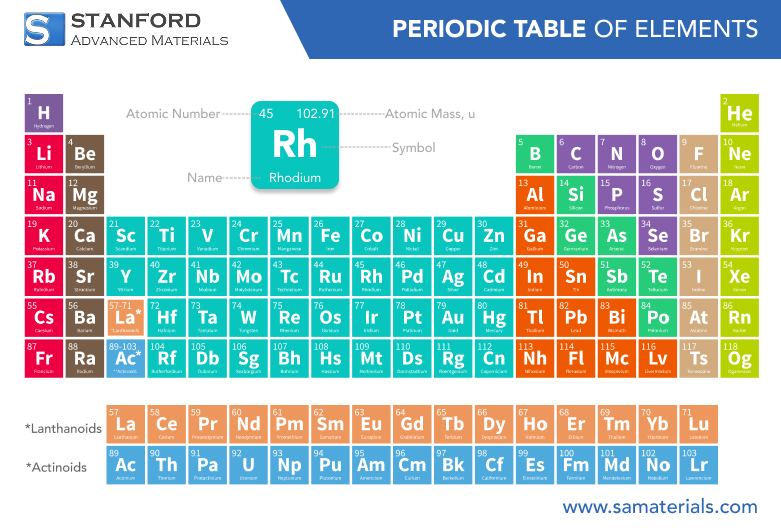
Atomic Number |
45 |
– |
|
Atomic Weight |
102.91 |
amu |
|
Density |
12.41 |
g/cm³ |
|
Melting Point |
1,964 |
°C |
|
Boiling Point |
3,695 |
°C |
Rhodium has excellent thermal stability with a very high melting point of 1,964°C that makes it perfect for performing at high temperatures. Its high density adds strength and toughness for resistance under severe conditions. In regard to electrical conductivity, rhodium is less conductive than either gold or silver, but its high reflectivity provides an excellent reflective coating in optical devices and premium mirrors.
Uses of Rhodium
Rhodium finds wide applications across various fields owing to its unique properties. The most common applications include:
1. Automotive Catalytic Converters
Rhodium is widely used in vehicle catalytic converters, which help in the reduction of harmful emissions through the transformation of toxic gases like carbon monoxide, hydrocarbons, and nitrogen oxides into less harmful substances such as carbon dioxide and nitrogen. This application accounts for a large part of global demand for rhodium.
2. Chemical Catalysis
Rhodium is used in the chemical industry as a catalyst in the production of nitric acid, acetic acid, and hydrogenation reactions. Its role in speeding up chemical reactions places it in an indispensable position regarding the production of a variety of important chemicals, whether for fertilizers or synthetic materials.
3. Plating Jewelry
Rhodium is usually plated on jewelry items, especially those of white gold and platinum, to give it an extra shine and resistance to tarnish. Its reflective surface gives the jewelry a brilliant, polished finish, with its corrosion resistance assuring that the jewelry retains its appearance over time.
4. Electrical Contacts and Reflective Coatings
With its excellent reflectivity, rhodium has become a highly sought-after material in the creation of top-of-the-line optical equipment, such as mirrors and reflectors. In electrical contacts, it finds application in cases requiring durability and resistance to corrosion.
5. Nuclear and Aerospace Applications
Because of its high melting point, rhodium finds some very specialized applications within both the aerospace and nuclear industries due to its resistance to corrosion. These characteristics enable it to retain structural integrity in extreme conditions, hence making it suitable for use in high-performance components.
Related reading: 10 Common Uses of Industrial Precious Metals

Production and Availability
Rhodium is one of the rarest elements on Earth, with annual production measured in kilograms rather than tons. It is primarily extracted from platinum ores, which contain small amounts of rhodium. Production involves mining platinum-group metals, followed by smelting and refining to isolate rhodium. Due to its rarity, rhodium can also be recycled, and recycled material accounts for approximately 10% of the total global supply.
Extraction and refining are a complex and costly process for rhodium. The high value and demand of the metal in automotive and industrial applications have made it a highly pricey material, with prices fluctuating considerably based on supply and demand dynamics within the global market.
Safety and Risks
Although rhodium is very resistant to corrosion and oxidation, there are no significant health risks under normal conditions. Note that the refining and industrial use of rhodium typically include handling platinum-group metal compounds, which can be dangerous if appropriate precautions are not taken. Work with rhodium and its derivatives should be carried out with adequate ventilation, personal protection gear, and following the standards for safety because of possible exposure to harmful substances.
Frequently Asked Questions
1. What is rhodium, and why is it valuable?
Rhodium is a rare, silvery-white metallic element that exhibits excellent catalytic properties, resistance to corrosion, and high reflectivity. Its main uses and value are derived from its application in car catalytic converters and chemical processes.
2. How is rhodium extracted?
Extracting rhodium from platinum-group ores involves an extended process by means of smelting and chemical separations. It is also recovered via recycling, accounting for about 10% of its total production.
3. For what purposes is rhodium mainly used?
The most common uses for rhodium include automotive catalytic converters, chemical catalysts, electrical contacts, reflective coatings, and for plating white gold, silver, and other jewelry.
4. Is rhodium used in the same way as platinum and palladium?
While rhodium does share certain characteristics with platinum and palladium, like being part of the platinum group of metals, it is actually more valuable for its main application in catalytic converters, whereas platinum and palladium have more diverse applications.
5. How sustainable is rhodium production?
The reasons are obvious: the scarcity of rhodium in nature and the complexity of the extraction process. Rhodium recycling from used catalytic converters, along with other industrial products containing this element, provides a more sustainable supply of the metal. However, mining and refining still pose serious environmental problems.


 Chin Trento