
 Products
 Bars
Bars
 Beads & Spheres
 Bolts & Nuts
 Crucibles
 Discs
Discs
 Fibers & Fabrics
 Films
Films
 Flake
Flake
 Foams
Foams
 Foil
Foil
 Granules
 Honeycombs
 Ink
Ink
 Laminate
 Lumps
Lumps
 Meshes
 Metallised Film
 Plate
Plate
 Powders
 Rod
Rod
 Single Crystals
 Sputtering Target
 Tubes
Tubes
 Washer
 Wires
Wires
 Converters & Calculators
 Write for Us



Sourcing, Ethical Procurement, and Recycling of Precious Metals

The role of precious metals lies at the core of high-technology and modern manufacturing. However, these metals remain rare in occurance, geographically localized, and difficult to mine and process. The following aspects related to these metals, therefore, can be deemed significant from the material perspective:
1. What are Precious Metals?
Precious metals are known as rare metal elements that have high commercial value, good corrosion and oxidation resistance, and superior functional properties. In industrial applications, some of the precious metals are gold (Au), silver (Ag), and the platinum metal series: platinum (Pt), palladium (Pd), rhodium (Rh), iridium (Ir), and ruthenium (Ru).
These metals are different from base metals in terms of scarcity as well as stability of performance. Gold has strong electrical conductivity in harsh environments; silver provides superior electrical and thermal conductivity; the PGMs have superior catalytic properties and high temperature stability. All these properties of precious metals are very essential in applications that demand reliability, accuracy, and durability.
2. Precious Metals Used in Manufacturing
Gold is considered to be one of the most common precious metals used in manufacturing. This is mainly in relation to electronics and semiconductors. This metal can be used as wire bonds, connectors, contact coatings, and high-reliability interconnects. This is primarily because it does not oxidize and will have stable electrical properties even after continued use for several decades. In aerospace, medical electronics, and high-frequency electronics, gold may be used despite its high pricing.
Silver has wide applications in electrical contacts, conductive pastes, photovoltaic cells, and RF parts. The high conductivity of silver makes it critically required in devices that demand low electrical loss. For instance, in the solar energy sector, silver paste is prominently a material component in crystalline silicon photovoltaic cells, contributing largely to the demand for silver.
Platinum and palladium are highly important in catalytic and high-end electronics applications. Platinum is used in chemical processing apparati, fuel cells, implant devices, and temperature probes, whereas palladium has significant uses in multi-layer ceramic capacitors, plating baths, and hydrogen applications. Rhodium, Iridium, and ruthenium have lower demands but are highly significant in high-temperature environments like sputtering targets, electrochemical electrodes, and high-end catalysts.
3. Sourcing of Precious Metals
The majority of precious metals are produced as primary mining production, as by-products of base metal mining, rather than as precious metal mining. Gold is more dominantly mined as primary mining, and PGMs are usually mined as by-products of nickel or copper mining.
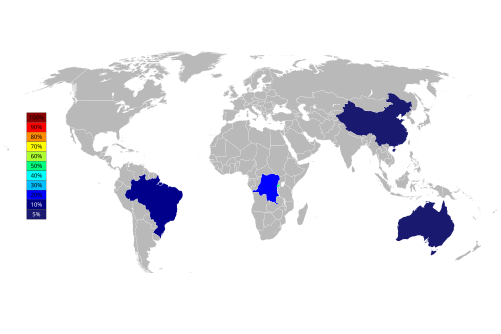
In terms of geography, precious metal reserves tend to be largely concentrated. China, Australia, Russia, and Canada are major gold-producing countries, and South Africa is a major source of platinum and rhodium, while Russia is a major source of palladium.
Mining precious metals requires huge resources. This is because the ore grade is very low, and in many cases, it is measured in grams of the precious metal in an ore of one ton. Such low-grade ore requires massive resources when mined. This explains why the environmental impact and the production cost of these metals are on the rise, pushing for sustainable production of these metals.
4. Ethical & Responsible Sourcing Of Precious Metals
Ethical sourcing of precious metals is currently one of the pivotal challenges in the precious metal supply chain. This is mainly owing to issues pertaining to working conditions, environmental degradation, land displacement, and funding of conflict by mining and refining companies.
Traceability, audit by a third-party organization, and compliance with global standards are some key points that are stressed in responsible sourcing guidelines. Nowadays, manufacturers are insisting that the precious metals they are getting must come from refineries that are following proper ethical and environmental guidelines. Special initiatives are being taken to ensure that there are no human rights abuses and no environmental damages related to metal extraction and processing.
For industries like electronics, healthcare products, and alternative energy, ethical sourcing has become non-negotiable. Today, customers, governments, and investors are holding companies accountable for their responsible sourcing of materials, and ethical sourcing has become an integral part of risk management for companies.
5. Recycling of Precious Metals
Recycling of materials is an effective mean of ensuring the supply of precious metals while at the same time addressing environmental issues. Precious metals have the advantage of being recyclable without losing value several times in the recycling process. Most of the time, the energy costs of recycling are lower compared to that of primary production.
Recycled gold, platinum, and palladium currently contribute to a large portion of the world supply. When it comes to PGMs, recycling is imperative in satisfying the demand in the industrial sector, particularly in the catalytic and electronics industries, where purity is of particularly high importance.
6. Sources of Recycled Precious Metals
The primary sources for recovering different precious metals are varied. For instance, gold, palladium, and silver are obtained from Waste Electrical and Electronic Equipment in the form of printed circuit boards, connectors, and semi conductors. On the other hand, platinum, palladium, and Rhodium are obtained from automobile Catalytic Converters.
Scrap generated through industrial processes, like used sputtering targets, electroplating baths, or catalyst residues, forms one of the top-ranking precious metal recycling materials, which have high quality. Another high-ranking group consists of medical or lab equipment, which contains precious metal wastes, like platinum, iridium, or gold, in highly purified forms.
7. How Precious Metals Are Reclaimed
Mechanical preprocessing generally precedes thermal and chemical treatment in precious metal reclamation. Preliminary operations such as dismantling, shredding, and separation are carried out to concentrate the metal-bearing fractions. Smelting is done to remove base materials and collect precious metals into metallic phases.
Final refining depends on hydrometallurgical and electrochemical techniques to separate individual metals and reach ultra-high purities. Modern refineries are quite capable of producing routine precious metals with purities of over 99.99%, fully suitable for semiconductor, electronics, and medical applications from recycled materials.
Frequently Asked Questions
1. Why are precious metals required in such electronics and semiconductors?
They provide stable conductivity, corrosion resistance, and high-temperature performance that make for long-term device reliability.
2. Can the precious metals from recycled sources meet semiconductor-grade requirements?
Yes, properly refined recycled metals can achieve purity of ≥ 99.99 % and find wide applications in electronics or medicine.
3. What is meant by responsible sourcing of precious metals?
It ensures responsible mining practices, supply-chain transparency, and compliance with environmental and labor standards.
 Chin Trento