Products
 Bars
Bars
 Beads & Spheres
 Bolts & Nuts
 Crucibles
 Discs
Discs
 Fibers & Fabrics
 Films
Films
 Flake
Flake
 Foams
Foams
 Foil
Foil
 Granules
 Honeycombs
 Ink
Ink
 Laminate
 Lumps
Lumps
 Meshes
 Metallised Film
 Plate
Plate
 Powders
 Rod
Rod
 Single Crystals
 Sputtering Target
 Tubes
Tubes
 Washer
 Wires
Wires
 Converters & Calculators
 Write for Us



Fracture Toughness: Enhancing Material Resilience

Understanding Fracture Toughness
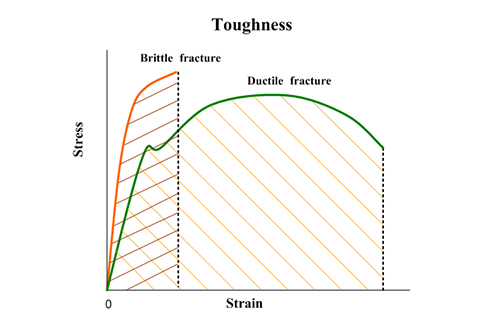
Fracture toughness is a critical material science property, which describes the capability of a material to resist cracking growth. It is required to predict failure under stress in structures and prevent catastrophic failure in engineering structures.
Critical Factors Influencing Fracture Toughness
• Ductility: The materials that can undergo plastic deformation (like metals) tend to possess higher fracture toughness.
• Microstructure: Grain size, phase composition, and defects can all affect fracture toughness. Materials with fine grain structure tend to be tougher.
• Temperature: Fracture toughness is a temperature function. Some materials become tougher at low temperatures (e.g., metals will have a brittle fracture at very low (cryogenic) temperatures).
• Processing and Reinforcement: Fabrication process (e.g., casting, forging, sintering) and reinforcement (e.g., fibers, stabilizers) can enhance fracture toughness.
Fracture Toughness and Material Variation
Fracture toughness varies widely between different materials due to differences in composition, microstructure, and processing. This is the way fracture toughness can vary among materials:
1. Metals
Metals have high fracture toughness relative to ceramics and polymers. The ability of metals to deform plastically (ductility) is one factor that contributes to their toughness. Some examples:
•Steel: The carbon steels can have fracture toughness of 50-150 MPa·m½, while more resistant alloys like high-strength low-alloy steels can have fracture toughness greater than 200 MPa·m½.
•Aluminum Alloys: Typically have lower fracture toughness (30-60 MPa·m½) compared to steels, but aluminum's light weight and corrosion resistance make it well suited for specific applications.
2. Polymers
Polymers are less tough in fracture than metals but can be engineered for specific applications.
• Thermoplastics: These will tend to have improved fracture toughness due to their ability to deform under load. For example, polycarbonate might reveal values of 30-70 MPa·m½.
• Thermosets: Tend to be more brittle and to have lower fracture toughness. Epoxies, for example, might reveal values as low as 20 MPa·m½ unless reinforced.
3. Ceramics
Ceramics are generally brittle, i.e., possess low fracture toughness, although the properties can vary extensively based on composition and processing.
• Alumina: Widely utilized as an engineering ceramic, alumina has 3-5 MPa·m½ fracture toughness.
• Zirconia: Also called high-fracture-toughness ceramic, zirconia may have fracture toughness between 5 and 15 MPa·m½, especially when yttria-stabilized.
• Silicon Nitride: A ceramic that can be abraded, widely used in industry and aerospace applications, silicon nitride is known to have values of about 5-7 MPa·m½ for its fracture toughness.
4. Composites
Composite materials, i.e., ceramic-matrix composites or fiber-reinforced polymers, may have extremely large ranges of fracture toughness value depending on matrix and reinforcement materials.
• Fiber-Reinforced Composites: Fracture toughness of carbon fiber composite, for instance, can range from 20 to 100 MPa·m½ based on orientation and fiber type.
• Ceramic-Matrix Composites: These possess the high-temperature strength of the ceramic along with the increased toughness of the reinforcing fibers to offer fracture toughness in the range of 10 to 30 MPa·m½.
5. Glass
Glass is typically brittle with very low fracture toughness compared to metals and ceramics. Fracture toughness of most glass materials will be around 0.5 to 1 MPa·m½, but certain designed glasses (e.g., laminated or toughened glass) will have slightly greater values.
6. Concrete
Concrete is a relatively low fracture toughness composite material but no lower than metals or polymers. Concrete's fracture toughness is usually in the range 0.5 to 1.5 MPa·m½, but this may be increased with the inclusion of fibers or other additives.
Testing Methods of Fracturance Toughness
Fracture toughness must be properly evaluated for materials. Several standardized test methods are employed:
Charpy Impact Test
A pendulum strikes a notched specimen, with the energy absorbed during fracture. It provides quick measurement of toughness but is less precise for detailed analysis.
Compact Tension (CT) Test
It includes tensile loading on a notched test piece so that the fracture toughness parameter such as KICK_{IC} can be measured precisely.
Single Edge Notch Bend (SENB) Test
A single edge notch specimen is bent until it breaks and provides data on material resistance to crack advancement.
Three-Point Bend Test
Similar to the SENB test but supported on three points, this test aids in the determination of fracture toughness under bending load conditions.
Instrumented Indentation
Complicated indentation techniques can estimate fracture toughness from the reaction of the material under controlled deformation.
Frequently Asked Questions
What is fracture toughness?
Fracture toughness is a metric for a material's capacity to withstand crack growth, maintaining structural integrity under load.
Why would one want to increase fracture toughness?
Increasing fracture toughness avoids unexpected material failure, guaranteeing safety and reliability in different applications.
What materials often exhibit high fracture toughness?
Steel and titanium alloys, and some composites, have high fracture toughness.
How does temperature influence fracture toughness?
Temperature change can alter the toughness of a material, typically decreasing at lower temperature and increasing at higher temperature.
How is fracture toughness different from hardness?
Fracture toughness evaluates resistance to crack growth, while hardness evaluates resistance to surface deformation and indentation.
 Chin Trento