
 Products
 Bars
Bars
 Beads & Spheres
 Bolts & Nuts
 Crucibles
 Discs
Discs
 Fibers & Fabrics
 Films
Films
 Flake
Flake
 Foams
Foams
 Foil
Foil
 Granules
 Honeycombs
 Ink
Ink
 Laminate
 Lumps
Lumps
 Meshes
 Metallised Film
 Plate
Plate
 Powders
 Rod
Rod
 Single Crystals
 Sputtering Target
 Tubes
Tubes
 Washer
 Wires
Wires
 Converters & Calculators
 Write for Us



Electric Susceptibility and Dielectic Materials

Understanding Electric Susceptibility
Electric susceptibility is a fundamental property that describes the extent to which a material becomes polarized when exposed to an external electric field. When a dielectric material is subjected to an electric field, polarization occurs due to the proper alignment of the dipoles within the material induced by the electric field itself. This polarization is directly linked to the material's electric susceptibility, which quantifies how easily the material can be polarized under an applied electric field.
Electric Susceptibility and Polarization
Polarization represents a process of separation of positive and negative charges within a material, hence creating electric dipoles. Polarization in dielectric materials occurs without the flow of electric current; for this reason, such materials serve as very good insulators. The strength of polarization in the material depends on both the strength of the applied electric field and the inherent properties of the material.
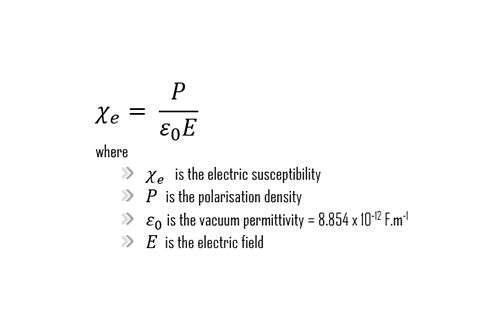
Electric susceptibility χ is expressed mathematically by the equation:
P=ε0*χe*E
Where:
- P is the polarization vector,
- ε₀ is the vacuum permittivity,
- χe is the electric susceptibility,
- E is the applied electric field.
This equation shows that polarization is proportional to both the strength of the electric field and the electric susceptibility of the material. The greater the susceptibility, the easier it is for a material to be polarized in response to an applied electric field.
Factors Affecting Electric Susceptibility
Several factors affect the electric susceptibility of a material:
- Material Composition: Materials containing dipoles that can easily align under an applied electric field indeed have higher electric susceptibility. For example, ferroelectric materials may achieve high polarization while diamagnetic materials exhibit less response.
- Temperature: With increasing temperature, the thermal motion destroys the orientation of the dipoles, and electric susceptibility decreases. Since higher temperatures mean increased agitation of the particles inside the material, the dipoles can no longer easily maintain alignment.
- Frequency of the Applied Electric Field: With increased frequencies, the dipoles may not be able to align fast enough with the oscillating electric field, which results in the reduction of electric susceptibility. This effect is more pronounced in those materials that have slower times of dipole response.
Types of Dielectric Materials and Their Uses
These materials, otherwise known as insulators, have become vital in many applications of electronic and electrical devices owing to their properties of storing and releasing energy in forms of polarizations. The different types of dielectric materials, together with their specific uses, are listed below:
1. Teflon
It is known that Teflon has excellent insulation properties, high thermal stability, and a low dielectric constant. As it has a low loss factor and very high resistance to chemical reactions, it finds wide application in cables, capacitors, and as an insulator in high-frequency applications.
2. Mica
Mica has high dielectric strength, excellent thermal stability, and low electrical loss. It is normally used for high-voltage electrical insulation in transformers, capacitors, and high-frequency equipment that demands the highest degree of reliability under extreme conditions.
3.Rubber
Rubber is flexible and has moderate dielectric strength, which makes the material most suitable for electrical insulation at low voltages. It is normally used on wires and cables, as the flexibility and insulation properties of rubber provide protection against electrical hazards.
4. Glass
Glass has a high dielectric constant and very good thermal stability. Because of its high dielectric strength, toughness, and the ability to perform well under high temperatures, it has a large number of applications in electronic devices: capacitors, insulators, circuit components, and so on.
5. Ceramics
Ceramic materials, like barium titanate, exhibit a high dielectric constant and strong piezoelectric effects. Because of their excellent dielectric properties and the ability to withstand very high voltages, these materials are commonly used in capacitors, piezoelectric devices, and ultrasonic transducers.
6.Polypropylene
It also possesses low dielectric loss and high insulation resistance, making it suitable for applications involving capacitors, especially high-voltage ones. With high insulation and low dissipation factors, the material will store energy efficiently and reliably.
Applications of Electric Susceptibility
Understanding electric susceptibility is important for several industrial and technological uses. A few significant applications are:
- Capacitors-Dielectric materials of high electric susceptibility raise the energy storage capacity of the capacitors. With improved polarization responses, these materials have the ability to let capacitors store higher amounts of charge with the same size and hence enhance their efficiency in power storage and energy conversion.
- Insulators: Materials possessing optimum electric susceptibility are utilized for insulation in electrical systems. These insulating materials impede the flow of electric current and maintain electrical integrity in cables, circuit boards, and transformers.
- Optical Devices: The design of optical components, such as lenses, waveguides, and fiber optics, involves selecting materials with specific electric susceptibilities aimed at controlling the propagation of light and electromagnetic waves. The polarization response in turn affects how light interacts with the material, influencing optical properties such as refraction and reflection.
Electric Susceptibility in Different Materials
Different materials have different electric susceptibilities, and are classified by their response to an electric field:
|
Material Type |
Susceptibility |
Behavior |
Examples |
|
Diamagnetic |
Negative, very small |
Weak repulsion to electric field |
Bismuth, copper, water |
|
Paramagnetic |
Positive, small |
Weak attraction to electric field |
Aluminum, platinum, magnesium |
|
Ferromagnetic |
Very large ( 10^3 to 10^6) |
Strong attraction and permanent polarization |
Iron, nickel, cobalt |
|
Ferroelectric |
Large ( 10^3 to 10^5) |
Spontaneous and reversible polarization |
Barium titanate, PZT |
|
Piezoelectric |
Large, dependent on stress |
Electric charge from mechanical stress |
Quartz, PZT |
|
Insulating (Dielectric) |
Positive, moderate |
Polarization in electric field, no conduction |
Teflon, rubber, glass, mica |
|
Superconductors |
Negative, very large |
Expulsion of electric fields, perfect conductivity |
Lead, niobium, YBCO |
Frequently Asked Questions
1. What is electric susceptibility?
Electric susceptibility is a measure of how easily a material can be polarized by an external electric field.
2. How does polarization take place in dielectric?
Polarization occurs through the alignment of dipoles under an applied electric field without the flow of electric current in dielectric materials.
3. Why is electric susceptibility important in capacitors?
High electrical susceptibility in dielectric materials allows the storage of more electrical energy by a capacitor, thereby increasing its capacity and efficiency.
4. How does temperature affect electric susceptibility?
Higher temperature can lower the electric susceptibility by disturbing the orientation of dipoles inside the material, hence lowering polarization.
5. Is electric susceptibility dependent on the frequency of the applied electric field?
Yes, because at higher frequencies, the dipoles may well not have enough time to align with the changing electric field, which reduces their electric susceptibility.
 Chin Trento