Products
 Bars
Bars
 Beads & Spheres
 Bolts & Nuts
 Crucibles
 Discs
Discs
 Fibers & Fabrics
 Films
Films
 Flake
Flake
 Foams
Foams
 Foil
Foil
 Granules
 Honeycombs
 Ink
Ink
 Laminate
 Lumps
Lumps
 Meshes
 Metallised Film
 Plate
Plate
 Powders
 Rod
Rod
 Single Crystals
 Sputtering Target
 Tubes
Tubes
 Washer
 Wires
Wires
 Converters & Calculators
 Write for Us



What Is Surface Tension

What Is Surface Tension?
Surface tension is a fundamental property of liquids by which the surface can resist external forces. It influences countless natural processes and underpins many modern technologies. In simplest terms, surface tension causes a liquid's surface to behave like a stretched, elastic film-strong enough for insects to walk on and crucial enough to control droplet formation in engineering systems.
Causes of Surface Tension
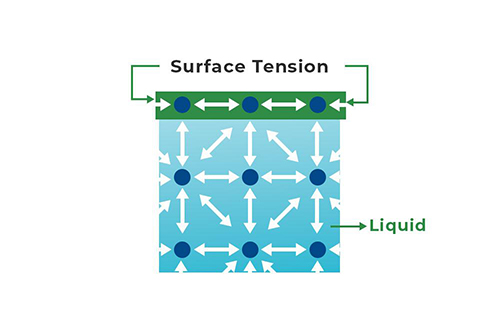
Surface tension results from the cohesive forces between the molecules of a liquid, which act in all directions inside the liquid. At the surface, however, these forces act essentially downward and sideways since there are no molecules above to balance them out. This results in a sort of "tightening" of the surface.
This effect is especially strong in water due to hydrogen bonding, which creates powerful intermolecular attractions. Consequently, the surface will contract to reduce area and, thus, form a stable boundary layer that resists deformation.
Measurement of Surface Tension
Accurate surface-tension measurements are important in coatings, inkjet printing, pharmaceuticals, and materials research. A number of standardized methods are used depending on precision requirements and sample characteristics.
Capillary Rise Method
A narrow tube is inserted into a liquid, and the height to which the liquid rises or falls is measured. This height is directly proportional to the liquid's surface tension and can be computed from known physical relationships.
Du Noüy Ring Method
It involves placing a thin metal ring onto the surface of the liquid and then pulling it up gently. The force exerted to pull the ring from the surface directly gives the surface tension. This is also a standard method in industrial quality control.
Wilhelmy Plate Method
In this technique, a vertical plate, usually made of glass or platinum, is partially immersed in the liquid. The force exerted on the plate by the liquid interface is measured and converted to surface-tension values. Due to its high accuracy, it is very often employed in material science and wetting studies.
Comparison of Methods for Measurement of Surface Tension
|
Measurement Method |
Description |
Application |
|
Capillary Rise |
Measures liquid height in a narrow tube |
Research laboratories |
|
Du Noüy Ring |
Assesses force to detach a ring from the liquid |
Quality control in manufacturing |
|
Wilhelmy Plate |
Calculates force on a submerged plate |
Material science studies |
For more information, please check Stanford Advanced Materials (SAM).
How to Break Surface Tension
Reducing or breaking surface tension involves disrupting the cohesive forces stabilizing the liquid's surface. Common ways of carrying out this include:
• Adding Surfactants: Soaps, detergents, and other surfactants weaken the hydrogen bonds between water molecules allowing for easier spreadability of the liquid.
• Temperature Increase: When the temperature of a liquid is raised, energy is added to the liquid, which weakens the intermolecular forces. This consequently reduces the surface tension.
• Mechanical Agitation: Stirring or shaking imparts kinetic energy to the mixture and disrupts the cohesiveness of the surface layer.
Examples of Surface Tension in Nature and Technology
• Water Striders: The reason these insects can perform their signature move of walking on water is due to the distribution of weight caused by their legs and high surface tension preventing them from breaking through.
Droplet Formation: Liquid droplets naturally take a spherical shape because surface tension minimizes the surface area.
• Inkjet Printing: Precise droplet formation relies on the control of surface tension for uniform and high-resolution printing.
• Detergents/Cleaning: Surfactants reduce surface tension, which allows water to spread over surfaces and into dirt and oils more effectively.
Frequently Asked Questions
What is surface tension?
The surface tension refers to the tendency of the surface of a liquid to resist external forces due to cohesive molecular interactions.
How is surface tension measured?
The most frequently used methods are the capillary rise technique, Du Noüy ring method, and Wilhelmy plate method.
The cause of water surface tension is
Strong hydrogen bonding between water molecules gives rise to potent cohesive forces at the surface.
How do surfactants affect surface tension?
The use of surfactants reduces surface tension by weakening intermolecular forces within a liquid so that it can spread and mix easily.
Can temperature change surface tension?
Yes. Higher temperatures reduce surface tension by weakening molecular attractions.
 Chin Trento