Products
 Bars
Bars
 Beads & Spheres
 Bolts & Nuts
 Crucibles
 Discs
Discs
 Fibers & Fabrics
 Films
Films
 Flake
Flake
 Foams
Foams
 Foil
Foil
 Granules
 Honeycombs
 Ink
Ink
 Laminate
 Lumps
Lumps
 Meshes
 Metallised Film
 Plate
Plate
 Powders
 Rod
Rod
 Single Crystals
 Sputtering Target
 Tubes
Tubes
 Washer
 Wires
Wires
 Converters & Calculators
 Write for Us



Reactivity in Chemistry

What Is Reactivity
Reactivity is a fundamental concept in chemistry that describes the ability of a substance to engage in chemical reactions. Highly reactive substances can easily form new compounds, while less reactive ones remain stable under similar conditions.
Reactivity indicates the propensity of a material to undergo chemical transformations. It depends on factors like atomic structure, bond strength, and environmental conditions. For instance, elements with a single electron in their outer shell, such as alkali metals, are typically highly reactive.
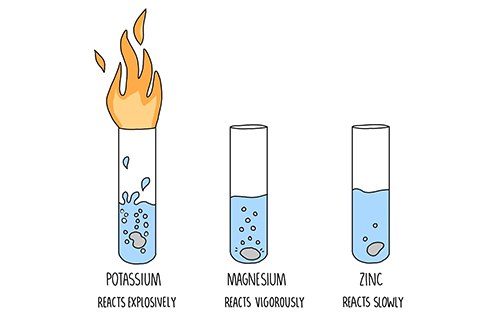
Chemical Reactivity in the Periodic Table
Chemical reactivity in the periodic table varies in a predictable manner across periods and groups. Here’s a brief overview of how reactivity changes:
Trends in Chemical Reactivity
1. Reactivity of Alkali Metals (Group 1): Alkali metals (e.g., lithium, sodium, potassium) are highly reactive, particularly with water. Reactivity increases as you move down the group, with cesium being the most reactive. This is due to the ease with which they lose their single valence electron.
2. Reactivity of Alkaline Earth Metals (Group 2): Alkaline earth metals (e.g., magnesium, calcium, barium) are also reactive, but less so than alkali metals. Reactivity increases down the group, as the atoms become larger and their valence electrons are further from the nucleus, making them easier to lose.
3. Reactivity of Halogens (Group 17): Halogens (e.g., fluorine, chlorine, bromine, iodine) are highly reactive, especially with alkali and alkaline earth metals. Their reactivity decreases as you move down the group, as it becomes harder for larger atoms to attract electrons to form negative ions.
4. Reactivity of Noble Gases (Group 18): Noble gases (e.g., helium, neon, argon) are generally inert because they have a complete outer electron shell. They rarely react with other elements, though some, like xenon and krypton, can form compounds under certain conditions.
5. Transition Metals (Groups 3–12): Transition metals (e.g., iron, copper, zinc) are less reactive than alkali or alkaline earth metals. They can form various oxidation states and are often used as catalysts in chemical reactions. Their reactivity varies, but they tend to form stable compounds.
Across a Period (Left to Right):
- Metallic Reactivity Decreases: Metals tend to lose electrons to form positive ions. As you move across a period, the elements become less metallic, and their ability to lose electrons decreases.
- Non-metallic Reactivity Increases: Non-metals, particularly the halogens, become more reactive as you move rightward. This is because they have a greater ability to gain electrons and form negative ions.
Metals Reacting with Water and Acids
Metals exhibit different reactions when exposed to water and acids, largely determined by their position in the reactivity series.
Reaction with Water
Highly reactive metals like potassium and sodium react vigorously with water, producing hydroxides and releasing hydrogen gas:
2Na+2H2O→2NaOH+H2
Reaction with Acids
Metals such as magnesium and zinc react with acids like hydrochloric acid to form metal chlorides and hydrogen gas:
Mg+2HCl→MgCl2+H2
Less reactive metals like iron react slowly, while very low reactive metals like copper do not react with acids under normal conditions.
Frequently Asked Questions
What determines a metal's reactivity?
A metal's reactivity is determined by its ability to lose electrons, influenced by its position in the reactivity series and its atomic structure.
Why do some metals react with water while others do not?
Metals that are higher in the reactivity series can displace hydrogen from water, leading to reactions, whereas lower-ranked metals lack the necessary reactivity.
How is the reactivity series useful in real-life applications?
The reactivity series helps in predicting metal behavior in reactions, aiding in processes like metal extraction and corrosion prevention.
Can non-metals have varying reactivity?
Yes, non-metals also exhibit different reactivity levels, influencing their ability to form compounds and participate in chemical reactions.
Why doesn't gold react with acids like other metals? Gold is positioned at the bottom of the reactivity series, making it highly resistant to corrosion and reactions with most acids.
 Chin Trento