Products
 Bars
Bars
 Beads & Spheres
 Bolts & Nuts
 Crucibles
 Discs
Discs
 Fibers & Fabrics
 Films
Films
 Flake
Flake
 Foams
Foams
 Foil
Foil
 Granules
 Honeycombs
 Ink
Ink
 Laminate
 Lumps
Lumps
 Meshes
 Metallised Film
 Plate
Plate
 Powders
 Rod
Rod
 Single Crystals
 Sputtering Target
 Tubes
Tubes
 Washer
 Wires
Wires
 Converters & Calculators
 Write for Us



Mass Diffusivity: Equation and Applications

What Is Mass Diffusivity
Mass diffusivity, abbreviated as DD at times, is the rate or measure at which the particles or molecules of a substance spread out in another substance, typically in a fluid system. It is a physical parameter that determines how easily a substance spreads out from a concentrated region to a diluted region. Diffusion is caused by molecular random motion and concentration gradients. Mass diffusivity is particularly relevant in a number of industries and scientific areas, including chemical engineering, biology, and environmental science.
Diffusivity Equation (Fick's Law)
The most widely used model that accounts for mass diffusion is Fick's Law of Diffusion. Fick's Law connects the diffusion flux (the amount of substance diffusing through a unit area within one unit of time) with the concentration gradient.
Fick's first law of diffusion equation is:
J=−D⋅(dC/dx)
Where:
•J is the diffusion flux (mol/m²·s), or the rate of diffusion.
•D is the mass diffusivity (m²/s), a measure of how readily a substance diffuses.
•dC/dx is the concentration gradient (mol/m³·m), or how the concentration of the diffusing substance varies over distance.
The minus sign shows that the flux is from high to low concentration, in line with the natural drift of diffusion to reduce concentration gradients. Fick's Law assumes a steady-state diffusion process, where the concentration gradient isn't altering.
For non-steady-state diffusion (where the concentration is altering with time), Fick's second law is used:
∂C*∂t=D*(∂^2*C/∂* x^2 )
This equation represents time-dependent concentration change and is common in applications such as diffusion in living organisms or in transient heat or mass transfer in engineering.
Factors Affecting Mass Diffusivity
Mass diffusivity (D) characterizes the rate at which a substance diffuses through a medium and is dependent on several key factors:
1. Temperature
Diffusivity is greater with higher temperature due to higher molecular motion. The diffusion coefficient of oxygen in water, for instance, goes up from 2.0 × 10⁻⁹ m²/s at 25°C to 3.0 × 10⁻⁹ m²/s at 50°C, demonstrating an ~50% increase in rate of transport of molecules.
2. Viscosity of the Medium
Increased viscosity slows down diffusion. As an example, glucose diffuses in water to the extent of 6.7 × 10⁻¹⁰ m²/s, while in glycerol, a more viscous fluid, the diffusivity is 2.2 × 10⁻¹¹ m²/s, almost an order of magnitude less, indicating how medium resistance impedes molecular flow.
3. Molecular Size and Mass
Large molecules take more time to diffuse. Sodium ions (Na⁺, with a diameter of 0.102 nm) diffuse in water at 1.33 × 10⁻⁹ m²/s, but a protein like bovine serum albumin (~66 kDa) diffuses at only 6 × 10⁻¹¹ m²/s, illustrating how weight and size directly impact mobility.
4. Concentration Gradient
Diffusion follows Fick's first law: more extensive concentration differences result in faster diffusion. In an example application, for oxygen diffusion within a microfluidic channel, the flux can increase from 10⁻⁷ mol/m²·s with a 0.1 mol/m³ gradient to 10⁻⁶ mol/m²·s with a 1 mol/m³ gradient, and it has very linear scaling with the gradient.
5. Nature of the Diffusing Substance
Chemical properties such as polarity and solubility affect diffusion. For example, hydrophobic molecules such as benzene diffuse in water at 1.2 × 10⁻⁹ m²/s, and polar molecules such as ethanol diffuse at 1.24 × 10⁻⁹ m²/s depending on the interaction of the molecule with the solvent.
6. Medium Properties
Medium. nature, porosity, density, and phase. determine diffusivity. Gas-phase diffusivity is. generally. orders of magnitude. larger. than. in. liquids; e.g., CO₂ diffuses in air at 1.6 × 10⁻⁵ m²/s but in water at only 1.9 × 10⁻⁹ m²/s. Effective diffusivity in porous media is reduced. by. tortuosity, relevant to such uses as gas separation in membranes.
Applications of Mass Diffusivity
Mass diffusivity is a critical parameter in many scientific and industrial applications:
1. Chemical Engineering: Diffusion is the driving force for many operations such as mixing, separation, and reaction kinetics. Diffusion rate impacts the efficiency of chemical reactions, especially catalytic reactions, in reactors.
2. Pharmaceutical Industry: Mass diffusivity is crucial in designing drug delivery systems. Controlled release formulations are based on understanding how drugs diffuse across membranes or other barriers within the body.
3. Biological Systems: In biology, mass diffusivity has a critical role to play in the explanation of processes such as oxygen and nutrient transport within cells and tissues and diffusion of signaling molecules in organisms.
4. Environmental Science: Diffusion is of vital importance for pollutant spreading in the air and water. Simulation of how substances diffuse in natural systems enables prediction of environmental impacts and remediation design.
5. Material Science: Diffusivity plays an important role in processes such as sintering, coating, and material production where materials are diffused into substances for changing their properties.
Values of Diffusion Coefficients
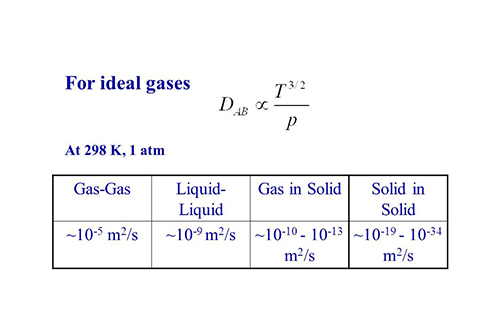
Diffusion coefficients vary significantly depending on the substance as well as the medium. For example:
•Water: Typical substances' diffusivity in water ranges from 10^-9 to 10^-6 m²/s.
•Air: Diffusivity of gases like oxygen or carbon dioxide in air tends to be higher, ranging from 10^-5 to 10^-4 m²/s.
•Solids: Diffusivity in solids is typically much lower, ranging from 10^-15 to 10^-10 m²/s.
Table 1: Diffusion Coefficients in Water
|
Substance |
Diffusion Coefficient (DD, m²/s) |
|
Oxygen (O₂) |
4.3×10−94.3 \times 10^{-9} |
|
Carbon Dioxide (CO₂) |
1.6×10−91.6 \times 10^{-9} |
|
Sodium Chloride (NaCl) |
1.3×10−91.3 \times 10^{-9} |
|
Glucose |
6.0×10−106.0 \times 10^{-10} |
|
Urea |
1.5×10−91.5 \times 10^{-9} |
Table 2: Diffusion Coefficients in Air (at 25°C)
|
Substance |
Diffusion Coefficient (DD, m²/s) |
|
Oxygen (O₂) |
1.94×10−51.94 \times 10^{-5} |
|
Nitrogen (N₂) |
1.78×10−51.78 \times 10^{-5} |
|
Carbon Dioxide (CO₂) |
1.60×10−51.60 \times 10^{-5} |
|
Water Vapor (H₂O) |
2.3×10−52.3 \times 10^{-5} |
|
Ammonia (NH₃) |
1.4×10−51.4 \times 10^{-5} |
Table 3: Diffusion Coefficients in Solids (at 1000°C)
|
Substance |
Diffusion Coefficient (DD, m²/s) |
|
Iron (Fe) |
4.8×10−144.8 \times 10^{-14} |
|
Copper (Cu) |
7.2×10−147.2 \times 10^{-14} |
|
Aluminum (Al) |
3.0×10−143.0 \times 10^{-14} |
|
Silicon (Si) |
1.1×10−151.1 \times 10^{-15} |
Table 4: Diffusion Coefficients in Polymers
|
Polymer |
Diffusion Coefficient (DD, m²/s) |
|
Polyethylene (PE) |
2.5×10−132.5 \times 10^{-13} |
|
Polystyrene (PS) |
1.0×10−131.0 \times 10^{-13} |
|
Polyvinyl Chloride (PVC) |
3.0×10−133.0 \times 10^{-13} |
|
Polypropylene (PP) |
1.3×10−131.3 \times 10^{-13} |
Table 5: Diffusion Coefficients in Gases (at 1 atm and 25°C)
|
Gas |
Diffusion Coefficient (DD, m²/s) |
|
Hydrogen (H₂) |
6.2×10−56.2 \times 10^{-5} |
|
Methane (CH₄) |
4.6×10−54.6 \times 10^{-5} |
|
Nitrogen (N₂) |
1.9×10−51.9 \times 10^{-5} |
|
Oxygen (O₂) |
1.9×10−51.9 \times 10^{-5} |
|
Carbon Dioxide (CO₂) |
1.5×10−51.5 \times 10^{-5} |
For more information, please check Stanford Advanced Materials (SAM).
Frequently Asked Questions
1. In what way does mass diffusivity differ from thermal diffusivity?
Mass diffusivity is the diffusion of particles through a medium, while thermal diffusivity is the diffusion of heat through a substance. Both are transport phenomena, but one involves mass transfer and the other involves heat transfer.
2. How does molecular weight affect the diffusivity of a substance?
Generally speaking, heavier molecules diffuse at a slower rate than lighter molecules because their higher size and mass reduce their mobility in a medium.
3. Is mass diffusivity ever constant in a system?
Mass diffusivity is usually considered constant in most cases, especially in steady-state cases. However, in cases where there are non-homogeneous systems or temperature gradients in the system, diffusivity varies.



 Chin Trento