
 Products
 Bars
Bars
 Beads & Spheres
 Bolts & Nuts
 Crucibles
 Discs
Discs
 Fibers & Fabrics
 Films
Films
 Flake
Flake
 Foams
Foams
 Foil
Foil
 Granules
 Honeycombs
 Ink
Ink
 Laminate
 Lumps
Lumps
 Meshes
 Metallised Film
 Plate
Plate
 Powders
 Rod
Rod
 Single Crystals
 Sputtering Target
 Tubes
Tubes
 Washer
 Wires
Wires
 Converters & Calculators
 Write for Us



Solvent Miscibility Table 101

Basics of Solvent Miscibility
Solvent miscibility deals with the ability of two liquids to mix. When two solvents mix in all proportions, they are said to be miscible. When they do not mix completely, they are called immiscible. The explanation behind these behaviors is simple. It often comes down to the nature of the solvent molecules.
There are a few key considerations that go into determining miscibility. First, polarity is a large factor. Polar solvents will mix well with other polar solvents. Nonpolar solvents will mix well with other nonpolar solvents. Second, hydrogen bonding is a consideration. Solvents that can participate in hydrogen bonding will mix well with other solvents that can also participate in hydrogen bonding. Third, molecular size is a consideration. Small molecules will mix well together, but larger molecules may have trouble arranging themselves in a homogeneous solution.
Solvent types include polar solvents and nonpolar solvents. Polar solvents will have molecules that possess a dipole moment. Alcohols and water are examples of polar solvents. Nonpolar solvents, such as hexane and benzene, do not possess a large dipole moment. In addition, solvents can be divided into protic and aprotic solvents. Protic solvents, such as water and alcohol, have hydrogen atoms bonded to oxygen or nitrogen. Aprotic solvents, such as dimethyl sulfoxide and acetone, do not possess this characteristic. This classification system is often used to determine which solvent to use in a chemical reaction.
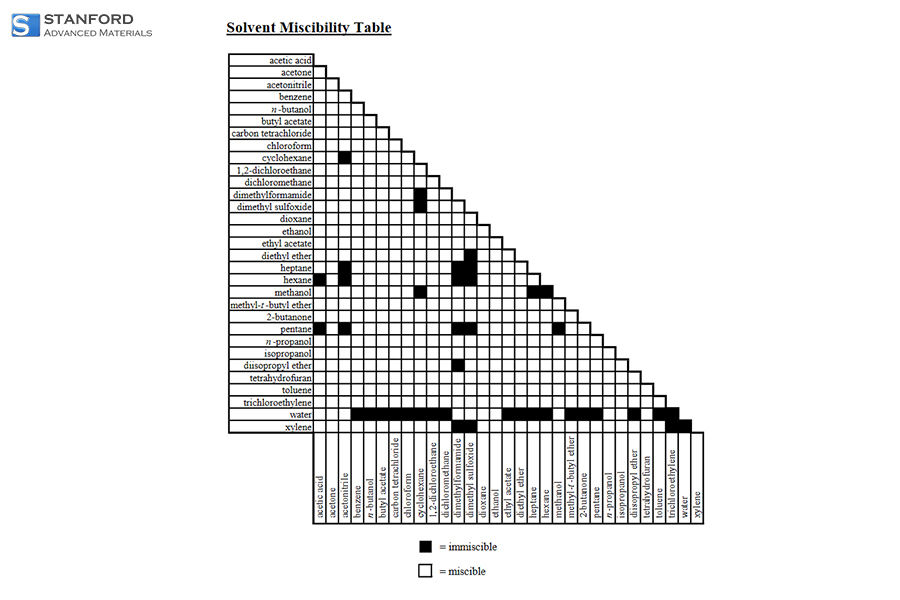
Structure of a Solvent Miscibility Table
A solvent miscibility table is a handy tool in the laboratory. The table lists common solvents in rows and columns. Each cell in the table gives the miscibility level between a pair of solvents. Sometimes, simple symbols or color codes are used to indicate how well the solvents mix. A common symbol is "M" for miscible. An "I" can represent immiscibility. In some tables, color coding helps to quickly spot which pairs mix well.
The table typically contains both polar and nonpolar solvents. It may include water, alcohols, hydrocarbons, polar aprotic solvents, and many others. It is very easy to read the table if you understand the meaning of the symbols used. A guide is usually provided at the beginning or side of the table. In a research environment, this table is very helpful. It provides a visual aid when designing a reaction or combining solution components.
Examples of Common Solvent Miscibility Pairs
Let us examine a few examples to better understand the concept. A typical example is the combination of water and alcohol. Water and low molecular weight alcohols are miscible in all proportions. This characteristic is employed in many chemical reactions and extractions. Another example is the combination of hydrocarbons and nonpolar solvents. Hydrocarbons such as hexane are miscible with other nonpolar solvents such as toluene.
There is also the issue of polar aprotic solvents and polar protic solvents. A common example of this is acetone and ethanol. The outcome depends on the specific combination of solvents. Generally, polar aprotic solvents do not mix as easily with polar protic solvents as they would with another polar protic solvent. Scientists often turn to miscibility tables to determine whether a combination of solvents will produce a homogeneous solution.
These examples demonstrate how scientists work in real-world settings. They illustrate that the correct combination of solvents is crucial. A glance at a miscibility table will reveal the correct combinations. This is important for ensuring that reactions are properly carried out and that the separation of products is smooth.
Applications of Solvent Miscibility Data
The data presented in a solvent miscibility table is very valuable. In chemical synthesis, the right combination of solvents can be used to control the course of a reaction. Before a reaction is carried out, a chemist may refer to the table. This is to ensure that the solvents are miscible, without causing any unwanted phase separation. For example, the combination of water and the right alcohol can create the right conditions for a reaction to occur smoothly.
Another significant use of the solvent miscibility table is in the process of separation and extraction. In the separation of chemical mixtures, immiscible solvents can be employed to separate different components. For example, in an extraction process, water and an organic solvent can be used. The solvent miscibility table can be used to determine which solvents can be employed to separate a desired product from other unwanted components.
The pharmaceutical and cosmetic industries also rely on solvent miscibility data. Proper formulation depends on mixing ingredients correctly. In the lab, testing solvent pairs helps in planning the most efficient extraction or separation method. Whether it is for an extraction of an active ingredient or ensuring that a cream has the right consistency, solvent miscibility plays a key role.
Conclusion
Solvent miscibility is at the heart of many laboratory and industrial operations. The factors such as polarity, hydrogen bonding, and molecular size play a leading role. A solvent miscibility table is a practical tool for chemists. It helps in reading information quickly and ensuring that the proper solvent pairs are selected. The examples given show that easy-to-read tables can make a difference in planning successful reactions and efficient extraction processes. Whether you work in research or industry, understanding solvent miscibility is essential for reliable and safe operations. For more tech information and support, please check Stanford Advanced Materials (SAM).
Frequently Asked Questions
F: How do we define solvent miscibility?
Q: Solvent miscibility is the ability of two liquids to mix in all proportions without forming layers.
F: What factors affect solvent miscibility?
Q: Polarity, hydrogen bonding, and molecular size are key factors affecting how liquids mix.
F: Why are solvent miscibility tables useful?
Q: They help in choosing the right solvent pairs for reactions, extractions, and formulations.

 Chin Trento